


Learnings from Stanford GSB: Wk 7

The final week of classes wrapped up with some guest speakers and a great talk on strategy and sustainability.
If you have been enjoying the blogs so far, do yourself (and me) a favour and sign up for notifications so you don't miss out on the next one : )
IP/Legal
Intellectual Property (IP) gives you exclusive rights that are legally recognised. This gives you leverage within a market, which can build your moat.
There are many types of IP but the common four are:
Trade Secrets
A secret business advantage (e.g. KFC's secret herbs and spices)
Only protected by secrecy. If the information is leaked, you have no recourse.
Copyright
Unique expression by the author (a song, an article etc)
Trademark
Brand of goodwill (e.g. logo)
Patents
Inventions (e.g. the design drawings for a new device)
Each type provides varying level of legal protection and requires differing upfront/ongoing maintenance

Data Protection and Privacy
With data breaches and hackers becoming more prevalent, it is critical to ensure that the data you are collecting from your users is stored securely. If you are planning to store an any personal data, ensure that you invest in keeping that data secure. Keep in mind that that personal data is becoming a heavily regulated space, which adds a lot of complexity and governance to your business.
Data breaches are not easy to detect unless you invest in monitoring. It is also critical to have a clear plan in place for what you will do in the event of a breach. You should role-play/simulate this regularly, so the entire team understands what needs to happen. This will greatly improve your response time and reputation should a breach occur.
Look at your entire supply chain and ensure that there are security obligations in all of the contracts. If your supplier has a data breach, are they obligated to tell you? Make sure they are.
AI Generated Content
I mentioned that copyright is the 'unique expression of an individual', so what happens when we start to bring AI into the mix. Generative AI is increasingly being used to create or edit content, but can work that has been touched by AI still count as a unique expression? In the US, District Court Judge Beryl A. Howell ruled that content generated by AI cannot be copyrighted. But what if you change the output from chatGPT? The US Copyright Office states in their guide that works containing AI generated content are not copyrightable without evidence that human creatively modified the output. This is something to keep in mind as it may effect whether or not you can file for copyright.
AI models like ChatGPT are constantly being trained by the materials which are fed into them. This can be dangerous for IP. If you get chatGPT to check your top secret trade secret document, it will learn the information and may use it to generate an answer for somebody else, which could compromise your IP. This is the reason that many companies have banned the use of ChatGPT on work devices.
Why Choose a Lawyer?
Unlike every other profession, lawyers are legally loyal to you. This means they aren't able to share any of the secrets that you divulge to them and that they are incentivised to act in your best interest. Their job is often to be a hard bargainer, which can be beneficial when closing deals. They are also naturally skeptical and like to have uncomfortable conversations. This can be invaluable as they will help you bring to surface all the potential flaws in your business.
Get in Quick!
Patents are processed on a first to file basis. Therefore, the earlier you can submit your patent, the better. You should also file for the patent before you disclose any information publicly. While the US has a 1 year period that an idea can be patented after the information has been made public, most countries are not like this, so if you ever intend on getting international patents, file early.
Legal Tips
As a founder, you will need to learn the basics of law. At the minimum you should understand:
Non-Disclosure Agreement
Employee Assignment
Contractor Agreements
While more complex contracts, should be left to a lawyer, these three documents usually can just be adapted from a template.
This might be a simple one, but get everything in writing. While verbal contracts are binding, they are hard to uphold. It is safer to just have all agreements in writing.
We mentioned this in a previous article, but have a clean separation from prior employers. This means that you quit prior to starting your new company, especially if it is in the same industry. This gives you a clean timeline and minimises the chances of your previous employer making a claim against you. Also, get rid of any confidential files or IP that you have from that company. All of this will help to make a clean separation and new timeline for your IP.
A common sign of success is when you start to get claims made against you. You should expect these disputes to come and be prepared. This includes notifying investors and fighting the battles that are worth fighting.
Always read the fine print. Your service providers may hide a clause in their terms & conditions/agreements that mean you can't sue them for using your IP. This was the case with AWS prior to 2017. They were free to use any IP hosted on their platform without being sued. By reading agreements you make sure that you maintain the integrity of your IP and the freedom to use it the way you see fit.
Tips from a Founder
This is probably the phrase i have heard most during my time here, but it was once again brought up. "Focus on finding product market fit". If your customers aren't lining up to buy your idea, then you haven't found PMF. This ties into something which I find extremely challenging. Shipping product quickly. “If you’re not embarrassed by your MVP , you’ve spent too much time building it than selling it”.There are so many examples of this, but Adam also mentioned the point that you should sell first. Even just setting up a landing page or a waitlist, where people can preorder your product. This helps to determine if you hav e PMF and also gives you the funds to go and build it. Another method that Segmed did was to have contracts signed where the customer would only pay once the product was built. This gave certainty to both parties and give great credibility when pitching to investors.
Feedback is an incredibly valuable tool to help develop your idea. However, if you implement everyones feedback, you may derail your idea and move away from your vision. It is important to be selective about the feedback we take on board. Wait until you have heard the same feedback at least three times before you incorporate it. This will help to remove the feedback that is less valuable.
Strategy & Sustainability
The course finished on an absolute high. This was easily the best class, taught by Professor William Barnett. We started off discussing business strategy before moving on to the power of sustainability as a disruptor.
There are two things that we are great at as humans
We are terrible at predicting
We are great at retrospectively rationalising
Let's explore these in more detail.
Strategy is the logic of why you might win. The problem is that a lot of businesses don't understand what the logic of their business is. For example, Stanford might think that the logic of their business is to sell courses and move on, when in reality they want to build very successful people who will come back and donate buildings/funds. It is the job of the leader to make sure that everyone in their team can explain what the logic of their business is.
Now, strategy is not necessarily something which was part of a grand vision. Strategy can be discovered. You can start with one strategy, put it out into the world and then alter and tweak it.

A great example of this is Apple, which used to be Apple Computers. They thought their strategy was making the best computers, but then after the successful release of the iPod and iTunes, they realised that their strategy was bigger than just computers, and so they rebranded to Apple.
This whole idea of strategy iteration goes back to the first point. We are terrible at predicting, so rather than trying to think of all the possible outcomes, put your strategy out into the world and then retrospectively rationalise. This can be a massive process of discovery and as leaders, it is our job, not to plan, but to figure out how to navigate the process.
It is easy for incumbents to stagnate their growth and performance, due to the lack of pressure from competition. The problem with this is that they become so bureaucratic and have so many processes, that when a disruptor comes along, they are unable to respond quickly and increase performance inline with the competitor.
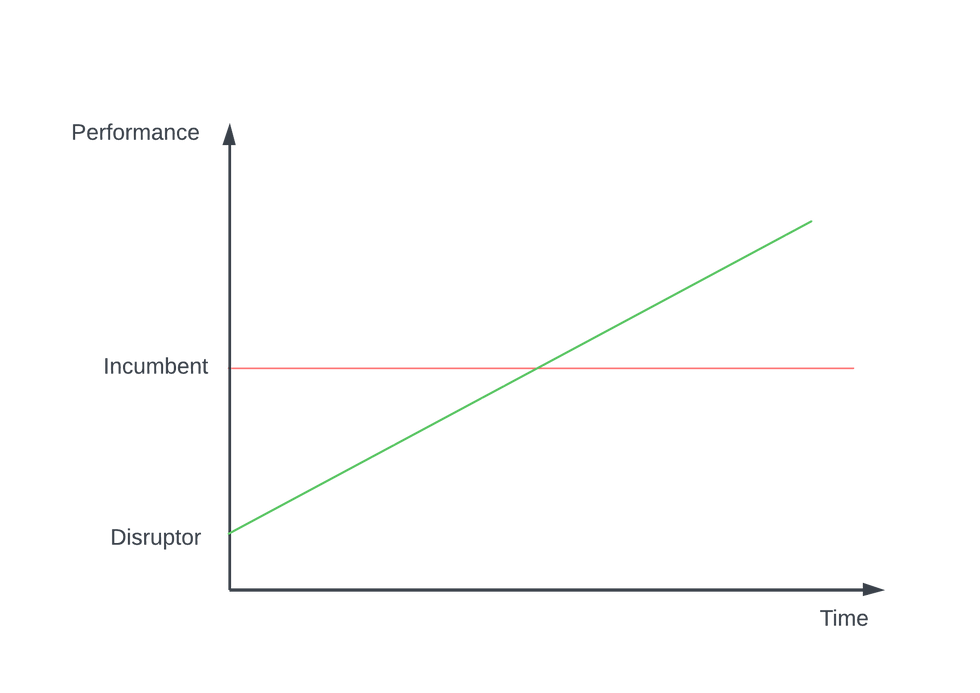
The best thing that ever happened to IOS was Android
You must build an adaptable business so you can survive disruption. One of the key ways to do this is by keeping an open mind. Often, incumbents see the new logic of the disruptors and simply dismiss it because they do not understand it. Only once the disruption occurs are they forced to adapt or collapse. When a change occurs, things get worse as the company undergoes a big shift to adapt. Process, people and products are all overhauled to improve the companies speed. Only once these changes occur, do things get better.

To avoid this dip in performance, companies should be running R&D in parallel to their current operations. This helps them to be ahead of the curve and be ready to flip the switch and start ramping, minimising or skipping the dip completely.
Consensus vs non-consensus
When we come up with a new idea, be it for a business or otherwise, the first thing we do is to go and tell someone. Why is this? Well, we want validation and also want to gauge whether or not it is a consensus idea.

VCs obviously want to back unicorn ideas and so they want to back non-consensus ideas. The problem is, they all end up hanging out together and this starts to produce a consensus. They all think they are talking about and supporting non-consensus ideas, but the simple fact that they are all talking about those ideas makes them consensus. Benchmark, a tier one VC, understood this fact and changed their decision making policy to reflect it. Now, if all partners agree to fund an idea (i.e. consensus), they turn down the idea. This avoids them investing in consensus ideas, which have a lower probability of being disruptors.
Usually, ideas start off being wrong and non consensus, then as changes in technology and society occur, the idea becomes 'right' but remains non-consensus. Only after it reaches mass market adoption does it then transition to consensus.
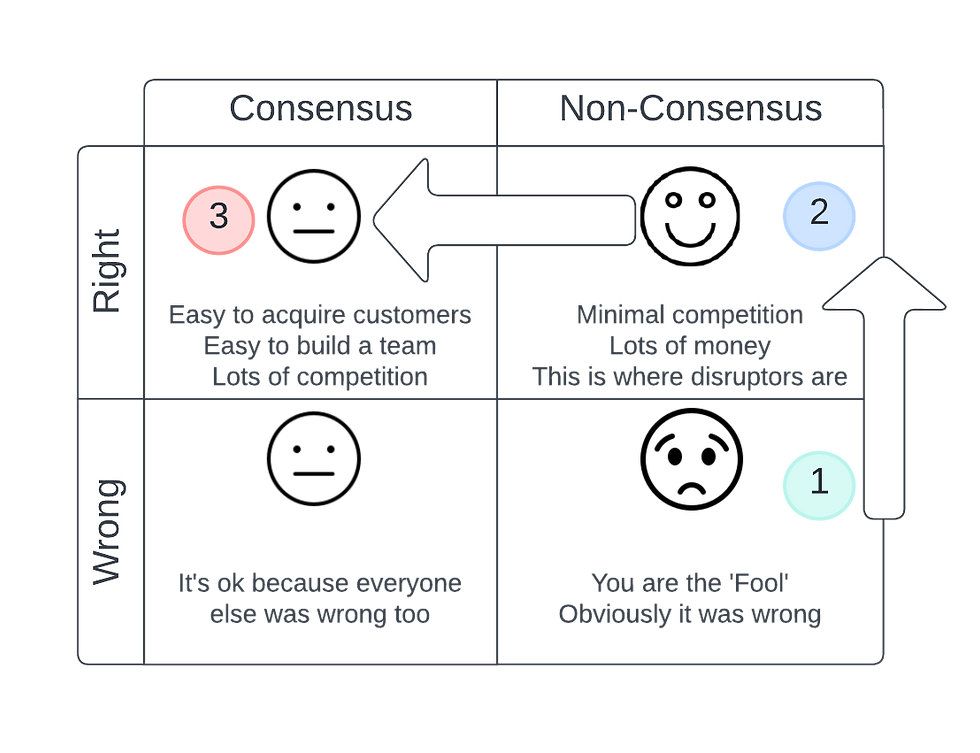
Usually, VCs will start to show up as the idea begins to transition from non-consensus to consensus. This mitigates their risk and shows market validation. However, their upside is limited by how early on in this transition they are able to invest. This is why preferential access to deal flow is critical to the success of VCs. The earlier they can hear about an idea becoming accepted by others, the earlier they can invest.
The secret is variance
In the process of innovation, ideas can be across the spectrum from foolish to genius. The green trace is is the natural variance in ideas that would occur (isn't always a normal distribution), with a spread of foolish and genius ideas. Organisations may say that they want to be innovative, but in actual fact they want 'smart' innovation. They want to control the innovation process and try to eliminate the 'foolish' ideas in an effort to drive up the mean, but this in fact drives down the variance and you end up with the red curve. Why is this? When you try to eliminate the 'foolish' ideas, what you actually do is minimise the non-consensus ideas. In the moment we can't discriminate between foolish and genius (We are terrible at predicting), we can only discriminate what is consensus and non-consensus.

The key takeaway here is to encourage your organisation to experiment a LOT! Don't judge ideas, let them be devised, then implement them and iterate. This will ensure that you capture all of the non-consensus ideas which will greatly improve your chance of becoming a disruptor.
A few final things on organisations
Competition at the company level is crucial to advancing and performing, but cooperation is what is needed at the personal level for you to build a sustaining culture. You should be fierce on the outside when dealing with competition, but then take great care of your people. This is the role of the leader.
Often we can get so caught up in company culture that we build too much bureaucracy and lose sight of the performance and staying competitive. However, there is also no better boost to your company culture than success.
Here is a link to a fantastic lecture by Prof. Barnett
Environmental Sustainability
We are at a pivotal moment. Just like we didn't see the mechanical revolution coming, which totally upended society and took away labour intensive jobs, we didn't see the digital revolution coming. Now, we are at the tipping point of a new revolution. The sustainability revolution. However, unlike previous revolutions, we know this one is coming. We know that we have to make changes and move to a more sustainable way of living, if we want life on earth to continue.
The 20th century was when we mastered mass production and consumption. The 21st century is when we will master sustainable production and consumption. The new generation who leads this transformation will be known as the greatest generation, and their companies will be known as visionary - William Barnett
There are three key things that need to happen in the next by the end of the century:
Reach Net Zero
Net zero energy production (Shift to Renewable Energy)
Greenhouse gas removal
Adapt the Biosphere
Improve agriculture and food production to accomodate growing population
Improve biodiversity and land use
Circular Economy
Reduce our materialism
Find alternatives to plastic
While the energy transition is already well underway, there is still much to be done to decarbonise the grid. While our current focus is looking to quickly shift the grid to renewables, thought should also be given to the cradle to grave/cradle impacts of this renewable energy infrastructure. Otherwise, we may be kicking the can down the road and creating future problems.
We also know that we have passed the point where net-zero is not enough and so carbon capture and storage will be required to draw CO2 from the atmosphere. Carbon markets will also play a role to get us to net zero, but so many countries are so focussed on building the 'perfect' carbon market before they implement it. As long as carbon is priced in at a non-zero value, then any market is better than nothing.
With the population growing, more demand is being placed on agriculture. This is leading to more land use and depleting of natural resources. A study by the University of Chicago has theorised that the theoretical maximum number of people that the earth can sustain is 10.2 Billion. To achieve this however, current agriculture and food supply will need to change, as well as changing the way we eat.

We will also need to improve our land use and bring rebuild biodiversity. A key principle to do this is to utilise Traditional Local Knowledge, which has been tried and tested over generations. This will help to rejuvenate land and bring back animals and microorganisms that are critical to sustaining an ecosystem. We need to put more emphasis on preserving our natural capital so that we can maintain these ecosystems for generations to come.
For a long time we have been told to recycle, but recycling plastics is not a sustainable practice. It is largely ineffective and due to the cross contamination, lots of plastic still ends up in landfill. The irony is that plastic was invented to improve sustainability. At the time, piano keys were made from ivory (elephants tusks) and so plastic was invented as a means to reduce the hunting of elephants. We now need a invention to replace plastic. In my opinion, the solution will need to be a like for like replacement and still provide the same level of convenience. This will accelerate the uptake and phase out plastics.
The day is coming when product market fit includes sustainability
It is not only about the impact on the planet, but also the inequity of the impact. Many of the communities getting hit the hardest by climate change are not the major perpetrators. Often, they are island/costal communities who have been living by sustainable practices for generations. Many local fisherman are struggling due to the consequences of overfishing and trawling. Unlike the large commercial fishing companies who can simply move their operations once a fishery is depleted, these locals are stuck bearing the consequences.
This was easily the best lecture to finish on, especially given my interests. We face a big challenge, but with big challenges come big opportunities! I am excited to see how our generation is able to innovate sustainably and hope to be at the forefront of this revolution.

Comments